
Virtual Horse Racing Betting Game Platforms UK
Three products, one phrase, one regulator.
 Available in US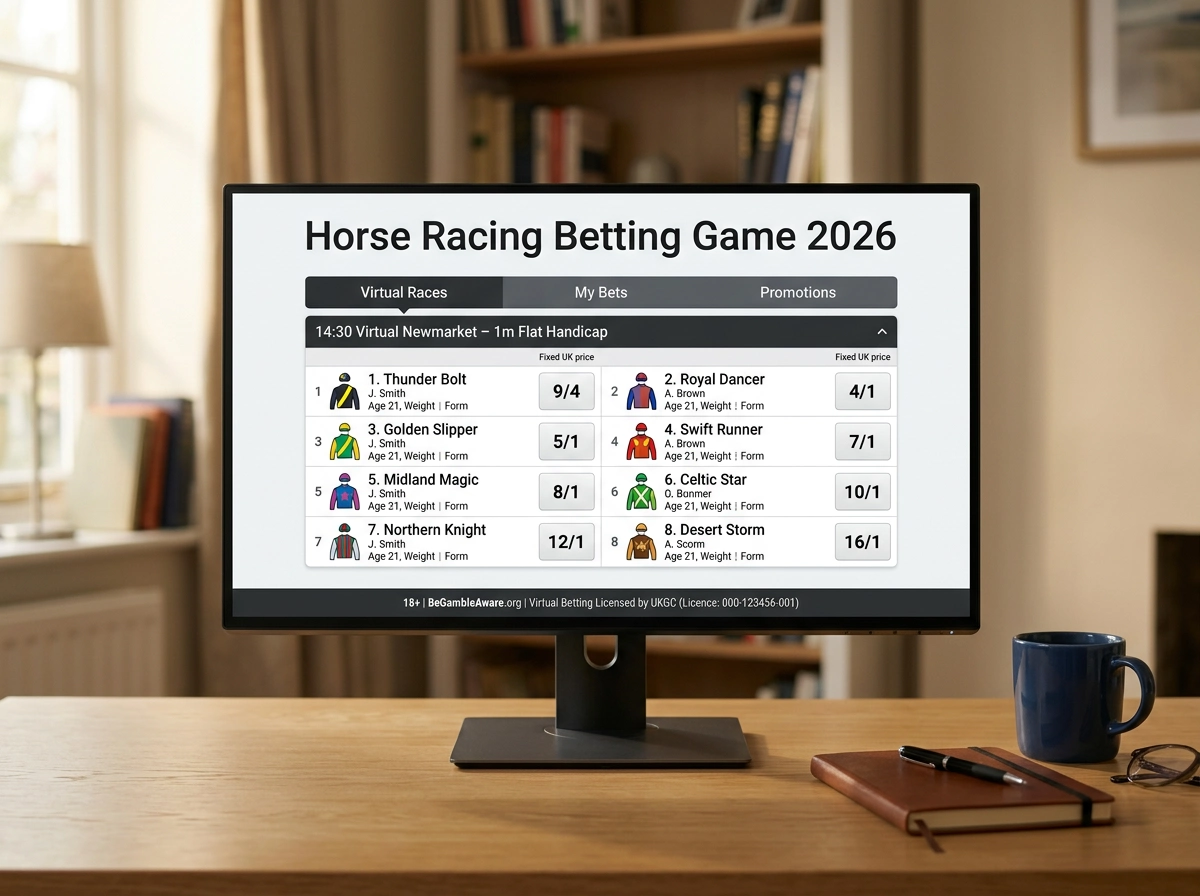
Defining the Modern Virtual Horse Racing Market in 2026
The phrase "horse racing betting game" used to mean one thing. You went to a bookmaker, you stared at a card, you backed something running at Kempton. In 2026 the same phrase covers at least three different products, and the punter who clicks the first ad without reading the small print has no idea which one they have opened.
I have spent the last eight years auditing virtual sports engines, mapping suppliers and writing about RNG behaviour for British punters. When somebody googles "horse racing betting game" today, they land on one of three things. First, regulated virtual horse racing — a real-money product under a UK Gambling Commission remote casino licence, where runners do not exist and the outcome comes from a certified random number generator. Second, a free-play simulator from the App Store or Google Play, branded "amusement only". Third, a hybrid: a free-play shell with paid in-app currency, sold as a game but priced like gambling.
The crucial point: in virtual horse racing the result does not come from a racecourse. A piece of software — a probability model — chooses the order of finishers under a weighting it was sold with. The cycle repeats every two to five minutes. The industry summary captures it cleanly: virtual horse racing is a computer-generated, fixed-odds betting product that simulates horse races on a rapid, repeating schedule. Outcomes are produced by a certified random number generator and a probability model created by the content supplier. Bookmakers display prices for each runner and settle bets exactly as they would for a real race.
Everything that follows — RTP percentages, supplier names, the £150 affordability threshold, the April 2026 duty change, the App Store labels — orbits around that one technical fact.
Before we go deeper, here is the brief. After that, the full picture.
The Tech Punter's Quick Brief
- "Horse racing betting game" in 2026 covers three products in the UK — regulated virtual racing, free-play simulators and coin-currency hybrids — and only the first is gambling in the legal sense.
- RNG-based virtual simulations make up roughly 77.6% of the global virtual sports betting market, forecast to grow from around 14.88 billion US dollars in 2025 toward 47.43 billion by 2032.
- Declared return-to-player on UK virtual racing typically sits between 80% and 92.1%, depending on supplier and bet type.
- From 1 April 2026, UK Remote Gaming Duty rises from 21% to 40%, which directly affects virtual sports margins and RTP bands.
- Free-play apps marketed "for amusement only" do not need a UKGC licence — but real money still leaves your card when you buy in-app coins.
Contents
- Defining the Modern Virtual Horse Racing Market in 2026
- The 2026 Picture: Virtual Sports, UK Betting and the Game Layer
- How a Horse Racing Betting Game Actually Works
- RNG and RTP: The Two Numbers Behind Every Round
- The Suppliers: Inspired, Playtech, Mohio, SIS and the Rest
- Bet Types: From Win and Each-Way to Trifecta and Exact
- Virtual vs Real: Two Products, One Phrase
- UK Regulation: The Combined Remote Licence, RGD and the £150 Threshold
- The Black Market and Why It Frames the Whole Question
- The Free-Play Side: Simulators, Coin Apps and the Apple/Google Line
- Responsible Play When the Round Restarts Every Two Minutes
- Choosing a Horse Racing Betting Game Without Being Marketed To
- Frequently Asked Questions
- How the Numbers in This Guide Were Picked
The 2026 Picture: Virtual Sports, UK Betting and the Game Layer
I keep a screenshot from August 2020 — empty grandstands at Goodwood, and the same week virtual racing turnover on UK operator screens hit a level I had not seen before or since. That month tells you why the horse racing betting game became a category in its own right.
Global virtual sports betting sat at roughly 14.88 billion US dollars in 2025, forecast at around 18% CAGR to about 47.43 billion by 2032. A different research house tracks 17.7 billion in 2025 rising to 110.5 billion by 2034. The numbers disagree on the destination but agree on the direction. RNG-based simulations — where horse racing lives — account for about 77.6% of the total. Virtual sports bets placed worldwide rose from 7.2 million in 2023 to 11 million in 2024 to 15.5 million in 2025.
Global virtual sports
14.88 billion USD in 2025 · forecast 47.43 billion by 2032 · CAGR around 18%
RNG-based share
77.6% of virtual sports market · B2C end-users 83.67% of demand
UK remote betting GGY
2.6 billion pounds in 2024–25 · horse racing 766.7 million · football 1.3 billion
Online share of UK racing
65.6% of turnover · 50.4% of GGY · digital is the default
On Britain: UK Gambling Commission statistics for April 2024 to March 2025 put remote betting gross gambling yield at 2.6 billion pounds — football 1.3 billion, horse racing 766.7 million. The wider remote casino, betting and bingo segment sits at 7.8 billion, with online casino games worth 5.0 billion and slots 4.2 billion. Active accounts: 24.4 million. New registrations across the year: 34 million, down 4.1% YoY.
The Gambling Survey for Great Britain Wave 2 (April–July 2025) put horse race betting participation in the last four weeks at 7%. Wave 3 (July–October 2025) dropped it to 4%, with overall online gambling participation at 39% — or 16% once lottery-only respondents are stripped out. Among 16-and-overs who bet: men 16%, women 4%.
How real racing sits inside the same numbers. Online betting accounts for 65.6% of UK racing turnover and 50.4% of its gross yield. Annual turnover slipped from 10.01 billion pounds in 2021–22 to 9.12 billion in 2022–23 — a real-terms fall of roughly 1.75 billion. In Q1 2025, total betting turnover on British racing fell another 9% year on year.
That decline is the gap virtual fills. The clearest case study is COVID — in August 2020, UK virtual sports revenue fell 16.1% month on month to 6.7 million pounds, 47.9% down from the April 2020 peak of 12.8 million. The peak existed because real fixtures were empty. William Hill once disclosed 18% of horse-race revenue from virtual at peak periods. The product layer is permanent.
15.5 million
Virtual sports bets placed globally in 2025, up from 7.2 million in 2023.

How a Horse Racing Betting Game Actually Works
I once sat behind an engineer running a virtual racing build. A function fired, a number came out, the number mapped to a horse. The race I had just "watched" had already been decided before the gate opened.
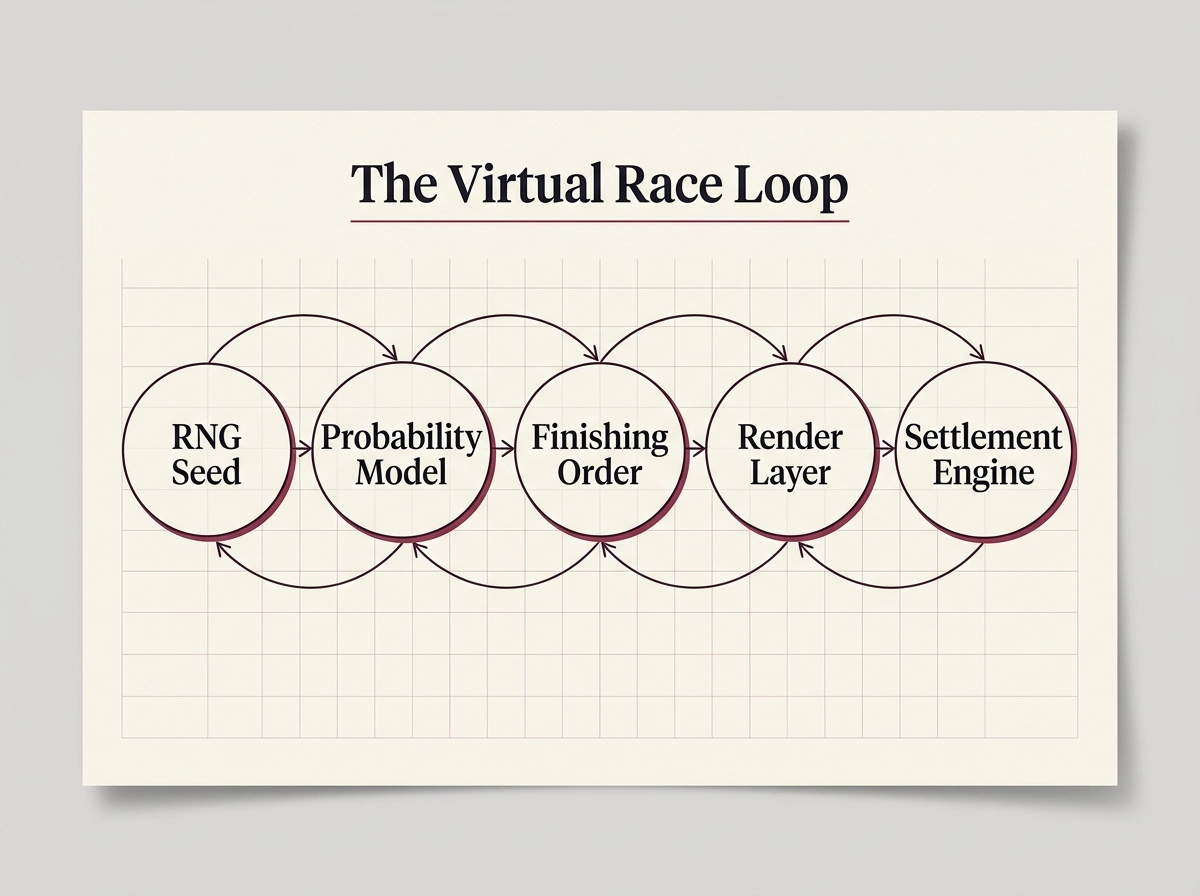
A horse racing betting game in 2026 is a five-step loop. An RNG produces a seed. A supplier's probability model converts that seed into a finishing order. A rendering layer turns the order into a 90-second video. The settlement engine pays fixed-odds bets against prices displayed before the gate opened. Two to five minutes later, the loop restarts.
Random Number Generator — the certified software inside a virtual racing engine that produces the unpredictable seed every race outcome is built from. In a UK product, the RNG must be tested by an approved laboratory before it runs live.
Two phrases inside that loop do the heavy lifting: probability model and fixed odds. The probability model decides how often each runner is "allowed" to win across thousands of races. A favourite at 2/1 has been weighted to land at a frequency matching that price, plus margin. The implied probabilities of all displayed prices sum to more than 100%, and the gap above 100% is the house edge. The RNG is the only source of true randomness; everything visible on the betslip is shaped around what the model knows about long-run distributions.
Two engineering schools. Most UK-facing virtual racing engines are pure RNG products — every race generated on the fly. The exception is Mohio Gaming, using pre-recorded historical races (six- and eight-horse formats on three- and four-minute cycles) with the betting layer wrapped around them. Both are accepted under UK rules, provided the random selection of which race plays next is itself RNG-driven and lab-tested.
The cycle is a commercial choice. William Hill virtual runs on five minutes; Mohio every three minutes for six-runner cards and four for eight; Inspired in the two-to-three-minute band; Paddy Power every two. The shorter the cycle, the more rounds a player goes through — and the more times a fixed house edge gets applied to their bankroll.
RTP is the percentage of total stakes the engine is configured to pay back across many rounds. Coral's virtual racing on Playtech is published at 90%. Inspired Racing varies between 80% and 92.1% depending on bet type. RNG-based simulations make up about 62.8% of virtual sports bets placed worldwide, with line-in-play formats 24.7%.
Worked example: a Coral virtual race at declared 90% RTP.
You stake 100 pounds across a theoretically infinite sequence of identical bets. At 90% RTP, the model returns 90 pounds and retains 10. Compare with a UK online slot at 95–97% and a National Lottery draw at around 50%, and virtual horse racing sits squarely between them.
An older industry editorial captures the trajectory: horse racing is a sport that dates back centuries and has not changed much in its process. However, with technological advancement, a new form of horse racing has emerged — Virtual Horse Racing.
For the full engineering walkthrough, see how virtual horse racing actually works.
Betting Simulator
RNG and RTP: The Two Numbers Behind Every Round
I once ran a test session of 600 rounds on a UK-licensed virtual product. The favourite, priced at evens, won 297 races — 49.5%, almost exactly what the price implied. Anyone watching shorter stretches had complained the favourite was "broken". The model was working. The sample was small.
Two numbers describe every regulated virtual horse race in Britain. The first is RNG certification status, audited by an approved lab. The second is declared RTP. Neither is optional under UK rules.
UK-facing virtual sports products have to be tested at either eCOGRA or Gaming Laboratories International. Those labs run chi-square tests for uniformity, autocorrelation tests for sequence independence, payout simulations across millions of synthetic rounds. Only after a pass certificate does the engine get cleared. A Combined Remote Operating Licence then sits on top. BetConstruct secured exactly that combined licence in 2019–2020 for a portfolio of eight virtual products including horse racing and greyhounds.
RNG certification is not a one-off badge. Labs re-test on every significant code change, and operators must keep the audit trail accessible to the regulator. If you see a UK-facing virtual racing product without a clear reference to an approved lab, treat that as a flag.
Coral's virtual horse racing on Playtech declares 90%. Inspired Entertainment's racing product spans 80% to 92.1% across bet types. Both are theoretical long-run averages across tens of millions of simulated rounds — not promises about any single race or bankroll.
Where the house edge sits in a simple 8-runner book.
Take a virtual race with eight runners and a declared 90% RTP for Win bets. The eight prices displayed imply probabilities summing to about 111.1%, not 100. That 11.1% gap is the "overround". Across thousands of races, Win players end up with about 90 pounds back per 100 staked. Move to trifecta and the same engine might run at 82–84% RTP — the exotic carries more variance, and the model lowers the long-run payout to absorb it.
| Product layer | Typical declared RTP band | What sits inside |
|---|---|---|
| UK online slots (regulated) | 92–97% | Player-by-player payback on each line |
| Virtual horse racing — Win bet | 88–92% | Fixed-odds settlement, overround in displayed prices |
| Virtual horse racing — exotics | 80–86% | Wider model variance, lower long-run payout |
| National Lottery draw products | around 50% | Prize fund as a fixed share of takings, good cause levy |
The industry voice on the duty change: many UK partners plan to adjust their RTP and bonusing structures to mitigate the tax increase. Declared RTP bands visible today are not stable through 2026.
RNG certification tells you the engine is not rigged. RTP tells you the engine is built to keep a margin. Both are true at once. A 90% declared RTP on a certified engine is not a flaw — it is the product, sold honestly. The risk is treating "certified" and "fair" as if they mean "you will not lose over time".
The Suppliers: Inspired, Playtech, Mohio, SIS and the Rest
Punters argue about bookmakers. Engineers argue about suppliers. Two competing UK bookmakers' virtual horse racing products look almost identical because they probably are — same engine, same probability model, different colour skin on the lobby tile.
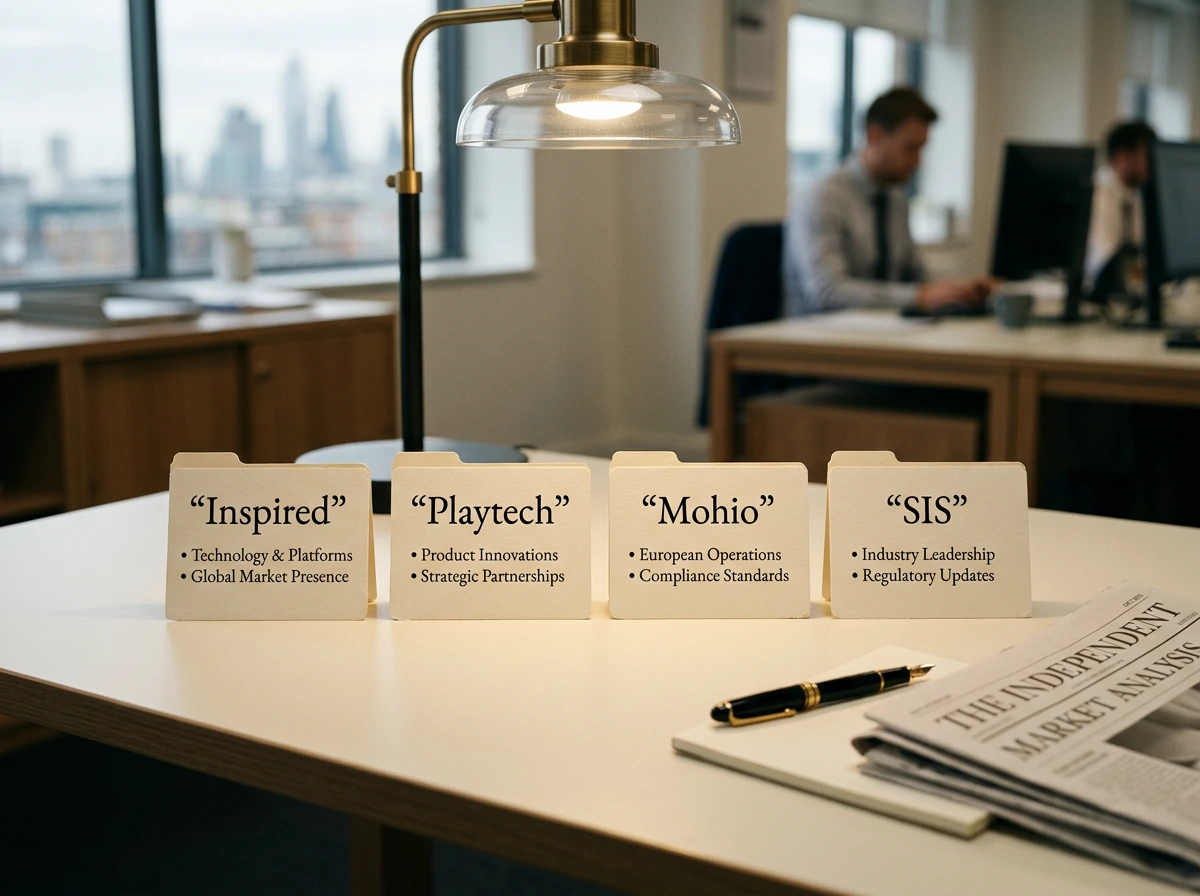
Inspired Entertainment is the biggest by some distance — the global B2B leader in virtual racing, with footprint across the UK, Europe and Latin America. Q4 2025 numbers tell the supplier story: record adjusted EBITDA margin of 42%, Interactive revenue up 53% YoY, Interactive EBITDA up 60%. Q1 2026 total revenue was up 29% YoY. Q3 2025 saw a 17% dip in Virtual Sports revenue, attributable to a Brazilian tax change. In February 2026 Inspired launched Virtual Horse Racing and Greyhound content in Turkey through Gametech. The racing portfolio covers Flat, Jumps and Sprint events.
Inspired Entertainment
RNG-based virtual horse racing · Flat, Jumps, Sprint events · declared RTP 80–92.1% by bet type · 2–3 minute cycles · UK, EU, LatAm, Turkey via Gametech
Playtech sits second, primarily through the engine powering Coral's virtual horse racing at declared 90% RTP. Runner numbers, prices and finishing order all flow through Playtech infrastructure even though the brand on the page is the bookmaker's.
Playtech
RNG-based virtual horse racing · declared 90% RTP on Win product · long-standing UK distribution including the Coral brand · part of a wider casino and sports stack
Mohio Gaming is the outlier. Their product is pre-recorded, not RNG-generated on the fly. Six-runner cards cycle every three minutes; eight-runner cards every four. GLI Europe BV certified. The bet menu — Exact, Perfecta, Quinella, Trifecta, In First 3, plus Over/Under and Even/Odd on finishing position — tells you the product was built for retail cashier deployments. Those last two are casino-style markets grafted onto a racing presentation.
Mohio Gaming
Pre-recorded historical races · GLI Europe BV certified · 6-runner / 3-min and 8-runner / 4-min cycles · markets include Exact, Perfecta, Quinella, Trifecta, In First 3, Over/Under, Even/Odd · retail cashier model
SIS — Sports Information Services — earns a place because of where its product slots in. SIS supplies the 49s lottery-style numbers product (a horse-race-styled numbers draw printing in UK shops every few minutes) and a virtual race feed used by retail and online sites. The punter taps once and the screen flips between products that look identical but carry different regulatory treatment underneath.
Inspired's racing has shipped variants for nearly every regulated market it has entered — Flat for daytime cards, Jumps for evening cards, Sprint for short-cycle product slotted between real fixtures. The portfolio is engineered for slot replacement during quiet sports periods.
The CEO of Inspired Entertainment on the 2026 UK duty change: many UK partners plan to adjust their RTP and bonusing structures to mitigate the tax increase. The bookmaker eats the tax, and the punter, indirectly, eats the consequent RTP recalibration.
For the full mapping of which UK bookmakers run which supplier's feed in 2026, see virtual horse racing suppliers in the UK.
Bet Types: From Win and Each-Way to Trifecta and Exact
Here is a question new punters ask more than any other: why does the same bet have three different names depending on which app I open? The horse racing betting game inherited its vocabulary from regulated markets that never agreed to standardise. Open an iHorse-style app and you will see "Place" and "Show". Open a UK bookmaker's virtual lobby and the same idea is called "Each-Way".
Each-Way — a UK bet split into two equal stakes: one on the runner to win, one to be placed. The place portion typically pays at one-quarter or one-fifth of the win odds for the runner finishing inside the top two or three.
Win is the simplest: back a runner to finish first. Place (Show in US naming) pays if the runner finishes inside the top positions defined by the operator. Each-Way packages those into a single ticket. If you stake 4 pounds each-way at 10/1 with quarter-odds and four-place terms, you are really staking 4 to win and 4 to place. Win pays 40 plus the 4 back; place pays a quarter of 40, which is 10, plus the 4 back. If your runner is second, you collect 14 against an outlay of 8.
| Bet type | UK naming | US naming | What you need |
|---|---|---|---|
| Single winner | Win | Win | Runner finishes 1st |
| Top-3 finisher | Place (in Each-Way) | Show | Runner inside top 2 or 3 |
| Win + Place bundled | Each-Way | — | Two stakes in one ticket |
| 1st and 2nd in order | Forecast | Exacta | Two runners, correct order |
| 1st and 2nd any order | Reverse Forecast | Quinella | Two runners, either order |
| 1st, 2nd, 3rd in order | Tricast | Trifecta | Three runners, correct order |
| Top 4 in order | — | Superfecta | Four runners, correct order |
Exotics matter for two reasons. First, they are where most of the variance in virtual product RTP lives. A trifecta at 80–84% earns the operator more long-run margin than a Win at 90%. Second, they are where the casino-game DNA shows up. A Superfecta box, covering multiple combinations of four runners across an entire field, looks far closer to a complex casino side bet than to a traditional racing wager.
Worked example: 8-runner virtual race, Win versus Trifecta.
You stake 10 pounds on the favourite at 5/2. Win: model pays 35 if correct, zero otherwise. Across 1,000 identical bets at 90% declared RTP, you keep about 9,000 of your 10,000 staked. Switch to a straight Trifecta at typical 82% RTP. Across 1,000 identical bets at 10 pounds, you keep about 8,200. The headline odds on a trifecta look more attractive, but the long-run number gives back less.
Mohio's product adds Even/Odd and Over/Under markets on finishing positions — pure casino-style binary bets dressed in racing colours. These markets are not unfair, but they are openly casino, not racing.
For the complete bet-type reference with UK and US notation, see bet types in a horse racing betting game.
Virtual vs Real: Two Products, One Phrase
A Saturday last March, after the real card had finished, somebody asked the question that always gets asked: "What's the difference, really?" The honest answer is: more than people think, along axes most punters never consider before they tap.
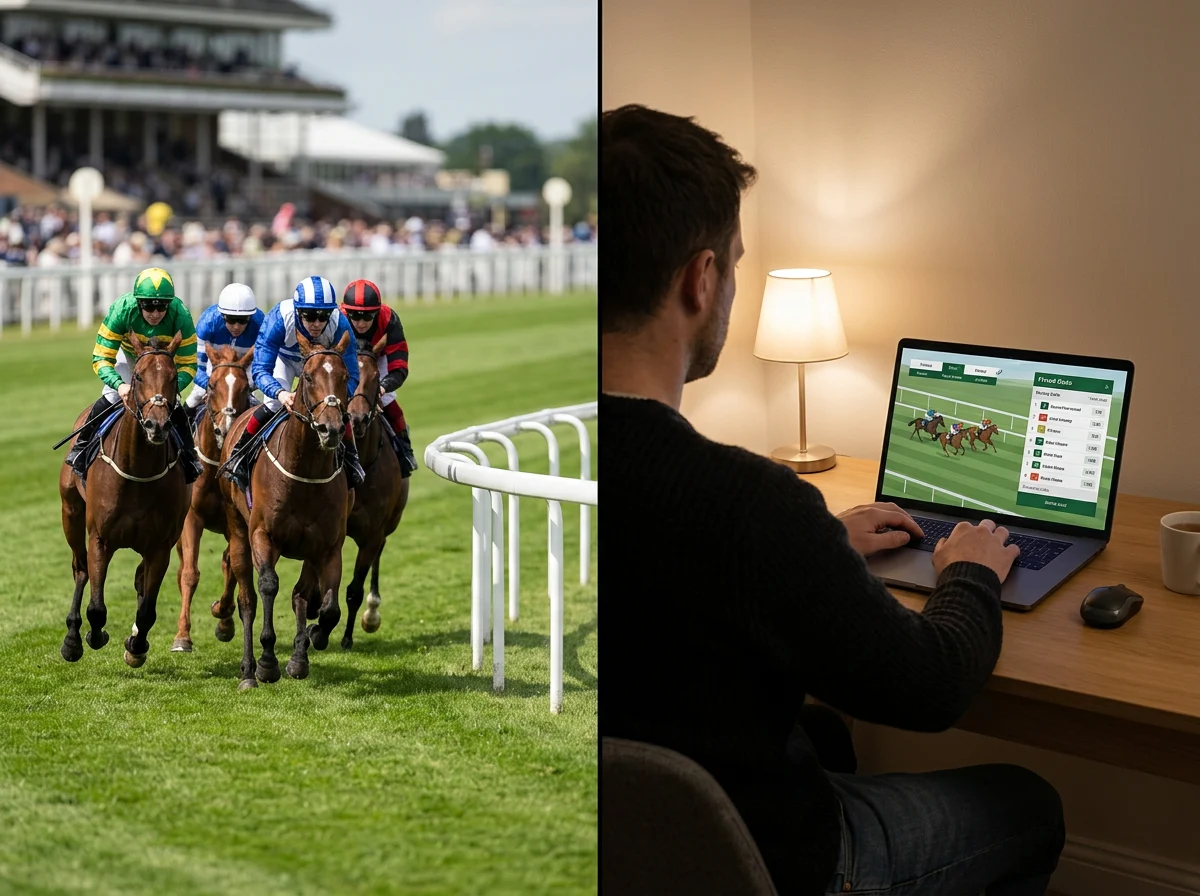
Real horse racing is a live event. Form, trainers, jockeys exist. The price reflects a market — bookmakers shading odds against each other, shortening the favourite in the final minutes because money came in. Virtual has none of that. The price you see was set the moment the race was generated, and it does not move because there is no market to balance.
| Dimension | Real horse racing | Virtual horse racing |
|---|---|---|
| Outcome source | Live event on a racecourse | Certified RNG + supplier probability model |
| Price formation | Market: bookmaker book, exchanges, late money | Fixed at issuance, no movement |
| Form analysis | Trainer, jockey, going, draw, weights | None — names are decorative |
| Cycle | Single race per slot, fixed by fixture list | One race every 2–5 minutes, 24/7 |
| Typical long-run RTP | Variable, structurally lower for exchanges than bookmakers | Declared 80–92.1% by bet type and supplier |
| Regulation | Combined remote betting under UKGC; levy to the sport | Combined remote casino under UKGC; no levy to racing |
| Risk profile | Stake-and-wait, single-event variance | Rapid-fire, repeatable, chase-loss prone |
The price-formation point should change how you read a screen. Real markets carry information. A horse drifting from 5/1 to 9/1 in the final ten minutes is the market telling you something. None of that is available on a virtual card. Reading form on a virtual race is like reading tea leaves: prior races have zero predictive value for the next one.
This is the line that traps recreational players. The names on a virtual card are persistent enough across a session that the brain starts looking for patterns. There are no patterns. Every race is generated independently. If a name "wins" twice in a row, it is statistical noise, not form.
Online betting accounts for 65.6% of UK racing turnover and 50.4% of its gross gambling yield. UK racing turnover declined from 10.01 billion pounds in 2021–22 to 9.12 billion in 2022–23 — a real-terms loss of roughly 1.75 billion. Q1 2025 saw a further 9% drop. The senior view inside the sport is unsentimental: total betting turnover has fallen by nine per cent compared with the same period in 2024. Whilst there is work to be done on the racing product to grow its appeal as a betting medium, there would be a much wider range of factors contributing to this concerning decline.
Problem-gambling rates differ between products. Health Survey data for England puts the problem gambling rate among horse-race bettors at 2.8% — roughly the level associated with National Lottery products. That figure is built on real-race bettors. Virtual racing, with its 2-to-5-minute cycle and absence of form-study, sits closer in risk profile to a slot product than to its real-race namesake.
British racing still pulled 5.031 million racecourse attendees in 2025 — first year above five million since 2019, under-18s up 17%. Real racing carries an industry around it: around 85,000 people in direct or indirect employment, generating 4.1 billion pounds annually. A portion of your real-race stake flows back through the levy. None of your virtual stake does.
For the head-to-head, see virtual vs real horse racing.
UK Regulation: The Combined Remote Licence, RGD and the £150 Threshold
People ask me what licence a virtual horse racing game needs to operate legally in Britain, and they usually expect a one-word answer. The honest version: it depends on which of the three products we are talking about. Real-money virtual racing, free-play simulators and coin-currency hybrids each sit under a different regulatory door.
A UK-facing virtual horse racing game on a UKGC-licensed operator requires a Combined Remote Operating Licence — the same category that covers online casino games. BetConstruct secured exactly that combined licence covering eight virtual products including horse racing and greyhound racing. The licence brings the full weight of the Licence Conditions and Codes of Practice. The RNG must be tested by either eCOGRA or Gaming Laboratories International before the product can go live.
What "Combined Remote" actually means. The Combined Remote Operating Licence is a single permission that lets an operator run multiple remote gambling product types under one regulatory wrapper. Virtual sports including horse racing are classified as remote casino, not remote betting, because the outcome is generated by software rather than by an external event. This is a regulatory line, not a marketing one, and it changes what duty applies.
From 1 April 2026, UK Remote Gaming Duty rises from 21% to 40%. That tax applies to remote casino gross gaming yield — which includes virtual horse racing. From Grainne Hurst, CEO of the BGC: forcing punters to hand over bank statements isn't "frictionless"; it's intrusive and will drive customers to the illegal market, where there are no safeguards at all.
The duty rise does not change what is legal. It changes what is profitable. Operators absorb the first wave of the tax and then adjust the consumer-facing levers: declared RTP, bonus generosity, market depth, free-play options. A product at 90% RTP through 2025 may be 88–89% by autumn 2026 without the player being notified directly. The number is in the help file, not on the betslip.
The affordability framework is the second active pressure. Since August 2024, UK operators run a light-touch financial vulnerability check at 500 pounds of net deposits in a calendar month. From February 2025, the threshold dropped to 150 pounds. Open data, public records, no document upload. A 150-pound monthly net deposit gets you through about 30 hours of session play at 5-pound average stakes on a 2-minute product.
The free-play side is the regulatory mirror. A free-play horse racing simulator app does not require a UKGC licence. The Gambling Act 2005 requires both a stake and a prize of money or money's worth — if the player can buy in-app coins but cannot cash anything out, the legal threshold is not crossed. The line between regulated and unregulated UK horse racing betting games is the cash-out test: if money can leave the account, it is gambling; if money goes in but cannot come out, it is a game.
For the full breakdown of where the legal line falls, see is a horse racing betting game real gambling.
The Black Market and Why It Frames the Whole Question
The first time a UK regulator showed me the audit trail on an offshore site advertising "real-money virtual horse racing", I stopped finding the topic theoretical. The site had no UKGC licence, accepted deposits in pounds, settled bets in pounds, and the only safeguard between a British player and total absence of recourse was Google's willingness to deindex the ad.
The International Federation of Horseracing Authorities tracks unique UK users visiting unlicensed sites betting on British racing — across 22 such sites between August 2021 and September 2024, traffic grew 522%. Licensed sites grew only 49% in the same window. In the first nine months of 2024, those unlicensed sites recorded roughly 600,000 unique UK-based visits per month. The Betting and Gaming Council estimates around 6% of all UK bets now move through unlicensed operators, with Cheltenham 2026 accounting for an estimated 60 million pounds of black-market turnover. The BGC's broader estimate: 1.5 million UK players spending up to 4.3 billion pounds annually on the unlicensed side.
An offshore site with horse-racing graphics looks identical to a licensed one. The site loads, deposit goes through, bets settle. The differences only show up when something goes wrong: no UK customer-protection regime, no GamStop coverage, no affordability framework, no certified RNG audit, no levy contribution to the sport, no obligation to honour withdrawal requests.
From Grainne Hurst: these parasite operators don't pay tax, don't care about safer gambling, and do not contribute a penny to the levy.
Independent polling backs up the friction argument. YouGov, working for the BGC, found 65% of UK bettors are not willing to hand over personal financial documents to an operator. That is two-thirds of the active customer base flagging the affordability framework as a behavioural threshold.
| Aspect | UKGC-licensed virtual racing | Offshore unlicensed product |
|---|---|---|
| RNG certification | Required, audited by eCOGRA or GLI | No verification |
| RTP disclosure | Declared in help file, regulated | Often absent |
| Affordability checks | Triggered above 150 pounds monthly net deposit | None |
| Self-exclusion (GamStop) | Mandatory coverage | Outside the scheme |
| Withdrawal recourse | Regulator complaint route | None |
| Tax and levy | 40% Remote Gaming Duty from April 2026 | Zero contribution |
The black market is a parallel category, growing five times faster than the regulated one. If you cross 150 pounds of net deposits in a month and do not want to engage with the affordability check, the rational answer is to pause, not to switch tabs.
The Free-Play Side: Simulators, Coin Apps and the Apple/Google Line
Open the App Store, search "horse racing betting" and the top result will be a free-play simulator with no UKGC licence. The description repeats a phrase across half a dozen products: "for amusement purposes only". That phrase is doing more legal work than any other in this category.
iHorse Betting is the cleanest case study. Version 7.1 was released on 14 May 2026 by Gamemiracle Company Ltd. The store listing categorises it as "21+ for amusement purposes only". Real money does change hands — players buy in-game currency — but no money can be withdrawn. The store description states the position: practice or success in this game does not imply any success at real money gambling. iHorse Betting: Bet on horse races does not manipulate or otherwise interfere with tournament outcomes in any way. Results are based entirely on luck and the choices made by players in the tournaments.
The Google Play side runs the same playbook. The Horse Racing Betting app under NV Gamepad combines virtual racing with slot-machine bonus games inside the same interface — racing-meets-slots, offline plus online sync, released at version 7.1 in May 2026. The Microsoft Store carries Windows-native versions dressed as casino-category entertainment.
| Store / product class | Cash-out | In-app currency | UK regulator | Age gate |
|---|---|---|---|---|
| Apple App Store free-play | None | Real-money purchase | Not UKGC; store policy | 17+ or 21+ |
| Google Play free-play | None | Real-money purchase, slot bonus games | Not UKGC; store policy | 17+ typically |
| Microsoft Store casino-class | None | Sometimes; varies | Not UKGC; store policy | 17+ typically |
| UKGC remote casino (virtual) | Yes — to verified payment method | Real money, real settlement | UKGC under LCCP | Strict 18+, KYC at sign-up |
Why the cash-out distinction matters legally. The Gambling Act 2005 requires both a staked sum and a prize of money or money's worth for an activity to count as gambling. iHorse, NV Gamepad's product and Microsoft Store casino-class titles do not allow cash-out, so the legal trigger is never pulled. They are video games that mimic gambling mechanics — a category the UK Culture, Media and Sport Committee has flagged for review but not yet recategorised.
Dr David Zendle at the University of York, giving evidence to the Culture, Media and Sport Committee: adults and adolescents who play social casino games are more likely to go on to engage in traditional forms of gambling, and spending on social casino games is linked to gambling problems.
The Culture, Media and Sport Committee's 2024 gambling regulation report formally recommended a review of children's access to social casino games — the first time a UK parliamentary committee acknowledged the category as a gambling-adjacent product worth recategorising.
Free-play horse racing simulators remain video games under UK law as of mid-2026. But the same monetisation patterns research links to downstream gambling harm — variable in-app coin pricing, "double or nothing" mechanics, daily login bonuses, time-limited offers — sit inside store-listed free-play products available to anyone over the store's age gate.
Responsible Play When the Round Restarts Every Two Minutes
Here is the uncomfortable arithmetic. On a 2-minute virtual racing product, a player who places a 5-pound stake every round is exposing roughly 150 pounds an hour to a house edge of around 10%. That is 15 pounds of expected loss per hour, before variance. The session math for virtual is not the math for real racing, where a punter places two or three bets across an afternoon card.
Gambling Survey for Great Britain Wave 2 put horse race betting participation at 7%; Wave 3 brought it back to 4%, with overall online gambling participation at 39%. Among 16-and-overs who bet: men 16%, women 4%. The problem-gambling indicator gives the category its risk profile: 2.7% of UK adults score PGSI 8 or above, and the 18–24 cohort runs at around 10%.
The 18–24 number is the one to take most seriously. Young adults are roughly four times more likely than the general adult population to score in the problem-gambling band. International readings echo this: the overall rate of high-risk problem gambling, which best correlates to gambling disorder, is 6%. Among adults ages 18 to 24, that jumps to a whopping 19%.
Dr Timothy Fong, Director of the UCLA Gambling Studies Program, on the people who reach his clinic: by the time they come to see me, it's metastasized, it's very severe. One of my recent patients was a woman who spent over $600,000 on a social casino app. The engine pattern — variable rewards on rapid cycles, real money in — is the same one a 2-minute virtual racing product runs on.
Chase-loss and the 2-minute cycle. The clinical signature of chase-loss is the decision to immediately recover losses by increasing stake size or bet frequency, made within seconds of the previous bet settling. A 2-minute virtual cycle is engineered for exactly that decision window. A 30-minute real-race interval breaks the loop; a 2-minute virtual race reinforces it. This is the single largest behavioural difference between virtual and real racing as betting products.

UKGC-licensed products carry the standard tooling: deposit limits, session limits, time-out periods, self-exclusion. GamStop covers self-exclusion across all UKGC-licensed sites. None of these tools work if you do not use them. The 18–24 cohort is also the cohort least likely to set a deposit limit at sign-up.
Set the limits before the session, not during it. The decision quality drops the longer the cycle runs.
Choosing a Horse Racing Betting Game Without Being Marketed To
Most punters pick the first virtual racing product the bookmaker lobby shows them. The lobby is sorted by commercial priority, not by what is best for the player. Here is what to look at instead, in roughly the order it matters.
First, the licence. A UK-facing product should display a UKGC licence number in the operator's footer, with the supplier's RNG certification accessible in the help file. If either is missing, you are not on a regulated product. The 6% of UK bets that flow through unlicensed sites get nothing from the licence, the levy or the RNG audit, and the player has no recourse if the operator stops paying out.
Second, the declared RTP and the bet type you use. Coral's product at a declared 90% RTP is a useful baseline for Win betting. Inspired's 80–92.1% range tells you the same engine pays very different long-run amounts depending on whether you bet Win or trifecta. If your habit is mostly straight Win wagers, optimise for the higher end. If you favour exotics, accept the lower long-run return and adjust stake size to keep expected loss within budget.
| Selection criterion | What to check | Where to find it |
|---|---|---|
| UKGC licence | Number visible, link active, operator name matches | Footer of the operator's website |
| RNG certification | eCOGRA or GLI test certificate referenced | Game help file or supplier disclosure |
| Declared RTP | Percentage stated for each bet type you use | Game rules page |
| Cycle speed | Time between race starts (2–5 minutes) | Lobby page or product description |
| Bet menu | Whether Each-Way, Forecast, Tricast are supported | Betslip preview |
| Responsible-play tools | Deposit limit, session limit, self-exclusion visible | Account settings before deposit |
Third, the cycle. A 5-minute product gives you twelve races an hour. A 2-minute product gives you thirty. The expected loss scales linearly with the round count, all else equal.
Account-setup checklist before the first stake
- Verify the operator's UKGC licence and supplier RNG audit reference.
- Set a deposit limit at your monthly budget, not at the threshold the platform suggests.
- Set a session-time limit that ends before fatigue starts.
- Confirm the declared RTP for the bet type you intend to use most.
- Note the cycle speed of the product you are about to open.
- Cross-check the bet menu against the bet types you actually want.
- Check that the operator passes GamStop coverage automatically.
The best horse racing betting game for a given punter is the one whose declared RTP, cycle speed and responsible-play envelope match how that punter actually plays. Marketing slogans about "realistic graphics" are decorative. The licence number, the RTP figure and the cycle time are the things that change the long-run outcome. Read them before you deposit.
Frequently Asked Questions
Is a horse racing betting game the same as real horse race betting?
No — and the difference is mechanical, not cosmetic. A real bet settles against a live event on a racecourse, where prices move with the market and form data has predictive value. A virtual bet settles against the output of a certified RNG and a probability model. Prices on a virtual card are fixed at issuance and do not move. Names on the runners are decorative. The virtual product shares the betslip layout with real racing but very little of the underlying mechanics.
How does virtual horse racing decide which runner wins?
A certified random number generator produces an unpredictable seed for each race. The supplier's probability model converts that seed into a finishing order, weighted so displayed prices reflect long-run win frequencies plus operator margin. The render layer turns the result into a 90-second video. The outcome is decided before the visual race starts. The RNG must be tested by either eCOGRA or Gaming Laboratories International for any UK-licensed product.
What is a typical RTP for a UK virtual horse racing game?
Declared RTP on UK-facing virtual horse racing products usually sits between 80% and 92.1%, depending on supplier and bet type. Coral's virtual racing on Playtech is published at 90%. Inspired Entertainment's product spans 80% to 92.1% — Win at the higher end, exotics at the lower end. The 1 April 2026 rise in Remote Gaming Duty from 21% to 40% has prompted suppliers to flag RTP recalibration during 2026, so check the operator's help file before each meaningful session.
Do free-play horse racing apps need a UK Gambling Commission licence?
Not under current UK law. The Gambling Act 2005 requires both a stake and a prize of money or money's worth for an activity to count as gambling. Free-play products like iHorse Betting allow real-money purchase of in-game currency but no cash-out — the prize threshold is never crossed. They are video games in the legal sense, governed by store policies, not the UKGC. The Culture, Media and Sport Committee has flagged this category for review, but the legal status has not yet changed.
Are virtual horse racing odds fair compared with real-race odds?
Fair in a different sense. Real-race odds reflect a market — bookmakers shading prices and balancing books across thousands of customers. Virtual odds are fixed at issuance and reflect the supplier's probability model plus operator overround. A virtual 8-runner race at 90% declared RTP carries about 11.1% overround. The odds are honest — they describe the model's actual long-run win frequencies — but they do not carry the market information a real-race price does.
How does the 1 April 2026 Remote Gaming Duty change affect a virtual racing game?
UK Remote Gaming Duty rises from 21% to 40% on 1 April 2026. Virtual horse racing sits under the remote casino licence category, so the new rate applies. Inspired Entertainment's CEO was direct: many UK partners plan to adjust their RTP and bonusing structures to mitigate the tax increase. In practice, declared RTP bands may trim during 2026, bonus structures are likely to tighten, and operators may consolidate around the most profitable formats. Re-check the help file through the year.
Where do affordability checks fit when I only play short virtual rounds?
UK affordability is account-level, not session-level. A light-touch financial vulnerability check triggers at 500 pounds of net deposits in a calendar month from August 2024, with the threshold dropped to 150 pounds from February 2025. Whether you spend on a 90-second virtual race or a 30-minute real one, the deposit total counts the same. The check uses open data sources, not document upload. About two-thirds of UK bettors flag the framework as intrusive; the regulator's position is that it catches harm early.
How the Numbers in This Guide Were Picked
A short note on what is inside the figures above. Every market-size number was cross-checked against at least two independent research outputs where they existed, and the wider band reported where they disagreed. UK-specific data was anchored to UK Gambling Commission industry statistics for the April 2024 to March 2025 reporting year, supplemented by the Gambling Survey for Great Britain Waves 2 and 3. RTP percentages reflect publicly declared supplier numbers — Coral at 90% on Playtech, Inspired at 80–92.1% across bet types — not estimates. Cycle times come from operator product pages. Quoted statements are from on-record industry voices. The 1 April 2026 Remote Gaming Duty rate is the figure announced at the Autumn Budget 2025.
I have not named bookmakers as recommendations anywhere in this guide. The few brand mentions sit as illustrative engineering — Coral on Playtech, Mohio's pre-recorded model, William Hill's historical 18% peak disclosure — not as endorsements. Picking a product is the punter's job. Picking the right framework to read the lobby is mine.
Articles
Created by the "Horse Racing Bet Game" editorial team.
